Amazon has replaced Item Detail Quality (IDQ) with Composite Data Quality (CDQ), introducing a more nuanced way of assessing product listing quality. Rather than simply rewarding listings with the right fields completed, CDQ focuses more heavily on accuracy, consistency and the customer experience, thus providing better direction for Amazon content optimization. In this post, we explain:
- What is CDQ?
- How does it compare with IDQ?
- What do Grade D and U mean and how they relate to egregious defects and policy violations?
- What kinds of issues can stop a listing from achieving an A grade?
What is the new CDQ?
CDQ, or Composite Data Quality, is Amazon’s updated scoring framework for evaluating the quality of product detail pages. It has replaced IDQ and is designed to reflect how customers actually experience listings when they shop. That means Amazon now places greater emphasis on the content shoppers see first, such as the title, images and variation set-up, while still assessing the supporting information further down the page, including attributes, bullet points and A+ content. The result is a scoring model that is more customer-focused and more sensitive to inaccurate or conflicting information.

How does CDQ compare with IDQ?
One of the most important changes is the structure of the scoring. Under IDQ, listings effectively accumulated points for including the right elements. Under CDQ, listings begin at 100% and lose points when Amazon detects missing, inconsistent or poor-quality content. The strongest weighting now sits in the “first screen” experience, particularly titles, images and variations, while structured attributes, bullet points and A+ content make up the remaining share. This means visible customer-facing errors can have a larger impact than before.
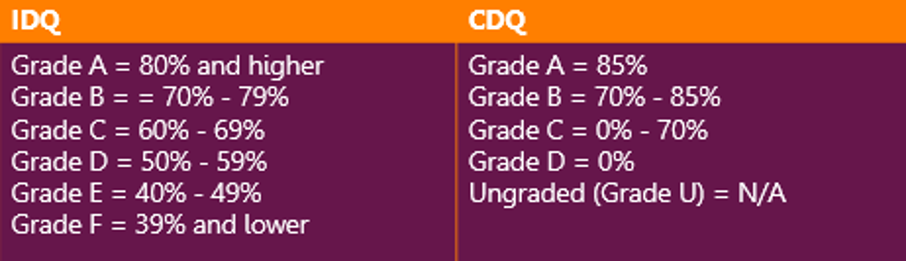
CDQ also introduces stricter treatment for more significant problems with product listings. If listings are particularly poor, they can be awarded a grade D or a grade U. These are essentially ‘fail’ grades.
What do Grade D and U mean?
A Grade D means the ASIN’s product details have an egregious defect and receives a score of 0%. A U grade means the ASIN is ungraded because there is a policy violation. Until this problem is resolved, Amazon cannot assign a normal CDQ score. In other words, both grades signal serious issues, but they are triggered for different reasons.
How do Grade D and U relate to egregious defects and policy violations?
Policy violations and egregious defects sit above normal scoring deductions because Amazon treats them as critical quality issues. A policy violation usually means the listing breaks one of Amazon’s content or data requirements, so the product remains ungraded until the issue is fixed. The severity of policy violations can differ, for example if a listing is missing a key attribute such as unit count, it can lead to listings being removed from search results. If a listing has a title policy violation, Amazon may not suppress the listing but it will still impact the quality and discoverability of the ASIN.
An egregious defect means the listing contains a serious mismatch or inaccuracy that could mislead a customer, which is why it drops to Grade D and 0%. Examples might include contradictory product information between the title, images and attributes.
Examples of issues that can result in a lower-than-A grade
Not every weak score comes from a critical defect. Many listings fall below an Grade A for composite data quality because of quality gaps that reduce trust, clarity or completeness. Common examples include:
- Titles that are missing key information, include redundant wording, or do not follow Amazon’s title guidance.
- Too few images, or images that do not meet expected quality standards.
- Variation issues, such as inconsistent size or pack-size values across a variation family.
- Structured attributes that are incomplete, inaccurate or contradictory.
- Bullet points that are missing, too thin, or not helpful to the customer.
- Missing A+ content – a core conversion element of a fully optimised listing
- Conflicts between different parts of the listing, such as the title saying one thing while an attribute or image suggests another.
In practice, some of Amazon’s CDQ recommendations may still need professional review. The CDQ feedback appears to be AI-assisted, which results in suggested corrections that do not accurately reflect the product, brand or key messaging. That means CDQ is useful for prioritising work, but it should still be sense-checked before changes are made.
How does Amazon’s CDQ drive content optimization?
Importantly, this change isn’t only about scoring, but about improvement. The errors or omissions flagged in the CDQ reporting come with recommendations about what to fix. The focus on customer experience means that making changes to Amazon product listings for fix issues will result in more appropriate feature in search results, and higher conversion rates.
Key takeaways
The key point to remember is that CDQ is not just a renamed version of IDQ. It is a stricter, more customer-focused model for assessing listing quality. It places more weight on the information shoppers see first, penalises inaccurate or conflicting data more heavily, and gives special treatment to critical issues. A U grade signals a policy violation that must be resolved before the listing can be graded. A D grade signals an egregious defect serious enough to reduce the score to 0%. For brands and content teams, the priority is clear: resolve policy violations first, fix egregious defects next, and then improve the weighted content areas that have the biggest influence on the customer experience and overall score.
Further information
To see a video about this change from an IDQ rating system to a CDQ that drives Amazon content optimization, click here