(Our model for structured Ad targeting and budget allocation)
The MinsterFB Cell Model is a platform-agnostic approach to audience targeting and curated shopper journeys. It helps us to allocate budgets according to objectives and ensure that the Amazon advertising strategy is effective in achieving those objectives.
What is the MinsterFB Cell Model?
The Cell Model is a way of thinking about and structuring advertising target audiences according to their propensity to purchase. It forms a crucial element of our Amazon advertising strategy which is different for each client and each set of advertising objectives.
Conventional wisdom says that Amazon Sponsored Ads are very effective at the pointy end of the funnel. They convert latent demand but do little to generate it. Conversely Amazon DSP advertising has a reputation as an awareness-generation tool with a poor ability to convert shoppers to purchase.
Our experience is that by using the Cell Model, both tools can do either job, and that when you combine them with the use of Amazon Marketing Cloud (AMC) they become even more powerful. Used in this way, Amazon ads can achieve almost any advertising objective.
How it works
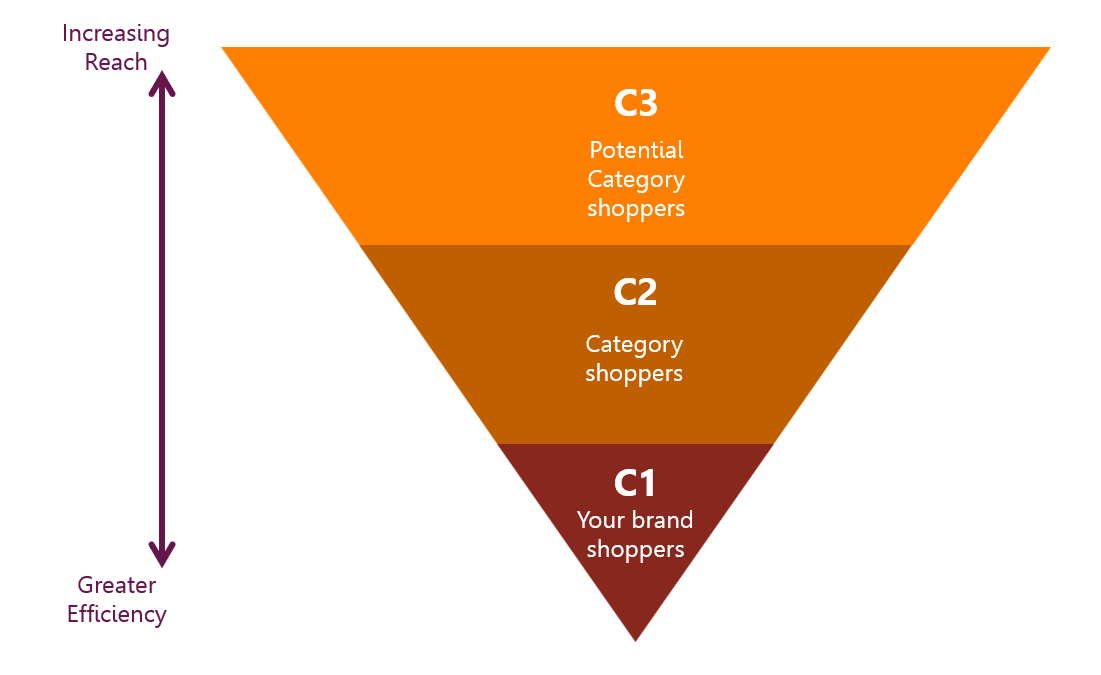
The first group, which we call Cell 1 or C1, is made up of shoppers who are already paying attention to your brand. We advertise to them either to encourage re-purchase at the relevant cadence, to cross-sell your other products or up-sell. The potential for growth within C1 is relatively small. Advertising here is more about defence. As a result, we would usually limit the amount of spend deployed against C1 audiences.
The second group, Cell 2 or C2, is made up of shoppers who are most likely to look for the particular
product you are advertising. This cell often has the highest budgets.
The third group, Cell 3 or C3, is made up of shoppers who are likely to be interested for some less direct
reason: perhaps they are shopping for a related product, or they share something in common with people who do buy it.
The way that ad targeting works on Sponsored Ads and DSP differs substantially, but the aim on either platform is to structure the targeting so that we know where each audience is within the funnel and how to re-target them based on what they do next.
Using the Cell Model across Sponsored Ads and DSP
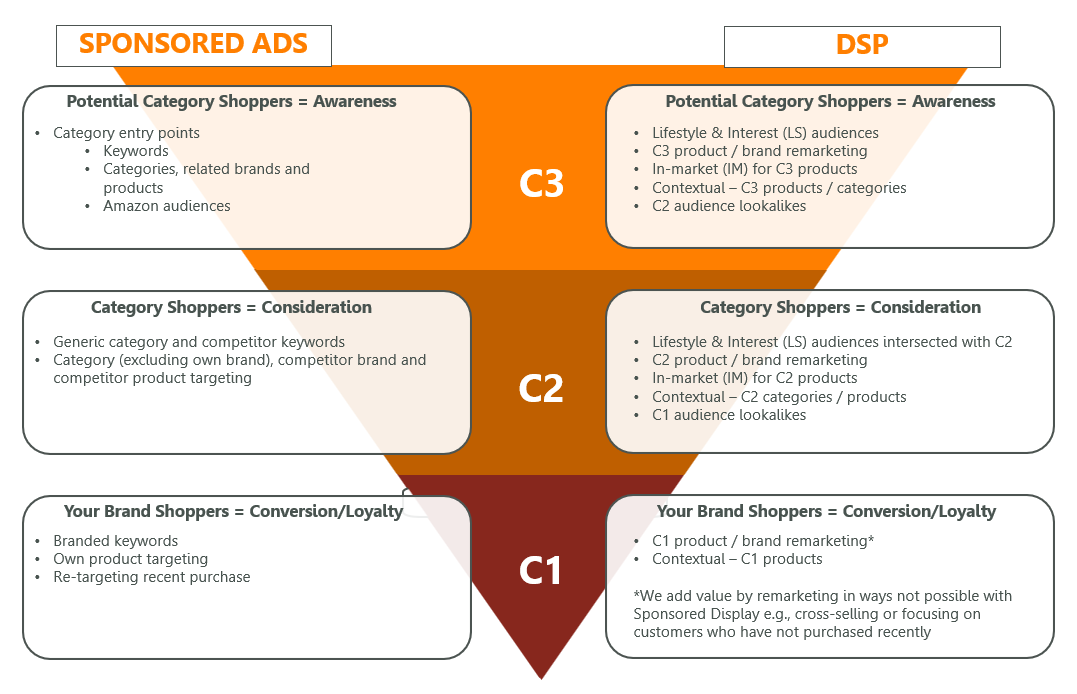
Sponsored Ads targeting centres on bidding for keywords and against products. If a shopper types the generic term for your product category in the search bar, then you know that they are in the market for your product and probably haven’t yet made their mind up about which brand to choose. However, if they search for a competitor or are looking at a competitor product detail page, they may still be open to persuasion. Both shoppers are in C2. They are showing clear signals of being in-market, but aren’t considering your brand. By targeting both shopping journeys with the same ads you can optimise towards the search terms that make progress. The ones that generate sales or branded searches (putting the shopper into C1).
By contrast, DSP targeting centres on the person rather than their behaviour in the moment. You can build DSP audiences based on their previous interactions with the category, your competitors or your own brand. Or you can use Amazon’s own audiences which use multiple signals to create segments such as In Market for your category, recent house-movers, new-to-market shoppers of particular categories, Lifestyle groups such as ‘House Proud’ or ‘Fitness Enthusiasts’, demographics etc etc. We can build cell-specific audiences for DSP advertising and can make them really precise by intersecting them. We can also use Amazon Marketing Cloud to make lookalike audiences.
Using the Cell Model In An Amazon advertising strategy
To bring the concept alive, here are some examples:
Using the Cell model to curate a journey towards purchase
At each level of the cell model, we can curate the journey depending on what previous ads someone has seen. This might involve showing them specific creative depending on what they have already learned about your brand (see below). Most importantly, though, we can make sure that if a shopper moves down a cell we maximise the chances of showing them a next-stage ad. We do this by creating AMC audiences. We can target these audiences directly from DSP or Sponsored Display ads. Or we can upweight bids for these audiences in the more standard Sponsored Ad formats. Either method allows the brand to over-index for shoppers who have seen upper funnel ads. This means your brand is more top of mind when shoppers enter the category. The same approach works to minimise competitor interference with your hard-won category shopper when they make a branded search.
Using the cell model to allocate budget between platforms and cells
If the Amazon advertising strategy needs to address low brand awareness, then we will need to allocate a significant proportion of the budget to C3 activity where we are achieving wide reach. In this case, branded search and the pool of previous shoppers is likely to be low. We would allocate maybe only 5% of your budget to C1.
However, unless you have a very long term view, you will also need us to try to generate some short term sales as well as awareness for long term growth. We would always recommend running C2 advertising which will serve when people are showing active engagement in the category. Using the magic of AMC we can upweight the bids in the C2 ads so that they are more likely to be shown to people who have already seen awareness advertising (delivered to a C3 audience). These people are pre-primed with your messaging and show a likelihood of visiting the category, so are the most likely to convert.
We can alter the split of spend between C2 and C3 depending on the results. If we are achieving wide reach with C3, and re-targeting those people with C2 advertising is working very well, then we might want to increase the C3 budget, knowing that it will improve results at C2. If there isn’t so much difference, then it will depend how long you are prepared to wait for returns on your investment. Move budget towards C2 if you need results more quickly.
Using the Cell model to match creative to journey stages
If your budget allows, then you can build different ads showing different creative depending on what previous ads the target audience has seen. If we are building awareness with C3 ads, we might need to introduce your brand or products with video content. Or use the bigger canvas provided by Static DSP ads which allows you to use image and headlines with a call to action.
Further down the funnel, if someone has watched to the end of a video ad, whether at C2 or C3, we are probably fine to advertise to them at C2 with a very simple ad that shows product and price. They are in the C2 targeting pool so they are showing engagement in the category. We know they understand something about your brand. So we can show them your top seller with the price and reviews. This is probably all we need to convert them.
For those who haven’t seen your video, if the product or brand needs a bit of introduction, the C2 ad should feature video (eg SBV or SPV) or provide links to the brand store where they can learn more (Maybe a Sponsored Brand store spotlight). We can distinguish between the people who have or haven’t seen the video by creating AMC audiences.
For C1 shoppers, the obvious route is to use a simple product-and-price ad as described above. However, when we’re advertising to a C1 audience, we know that they are engaging or have engaged with your brand. They are likely on a mission to purchase a product they already know about. Advertising to C1 shoppers is primarily about defence, ie reducing the impact of competitor ads. But the way that you occupy that space makes a difference. Using ad formats such as Store Spotlight Sponsored Brand ads can show several ranges of additional products to explore. This provides a cross-selling or up-selling opportunity.
Summary and conclusions
The cell model underpins our delivery of various Amazon advertising strategies.
Sponsored Ads are primarily targeted by:
- Search terms/keywords
- Specific product targets
- Target product categories
- Target brands
Thinking about which keywords and products sit within each level of the cell model enables us to partition the ad spend and to be clear about which creative to show to which audiences. We can upweight bids for AMC audiences, or directly target them with Sponsored Display ads.
DSP ads can be targeted by:
- Amazon lifestyle and in market audiences (multi-signal approach)
- Previous browsing and shopping behaviour (for your products of competitors)
- Lookalike audiences based on seed audiences (eg your new-to-brand shoppers, or your e-mail list)
- Demographics
- Media consumption
- Previous ad exposure
- And more
We can intersect these targeting types to give really promising audiences at C3 levels, which helps to give the DSP platform its reputation for delivering at the awareness level. For example, you can reach women who have previously searched for beauty products and live in London. This is still a big enough audience to move the dial, but precise enough to be highly promising compared with ‘women aged 25-44’ or other more generic audiences.
Retargeting within or between platforms helps us to curate the shopper journey towards purchase more effectively.